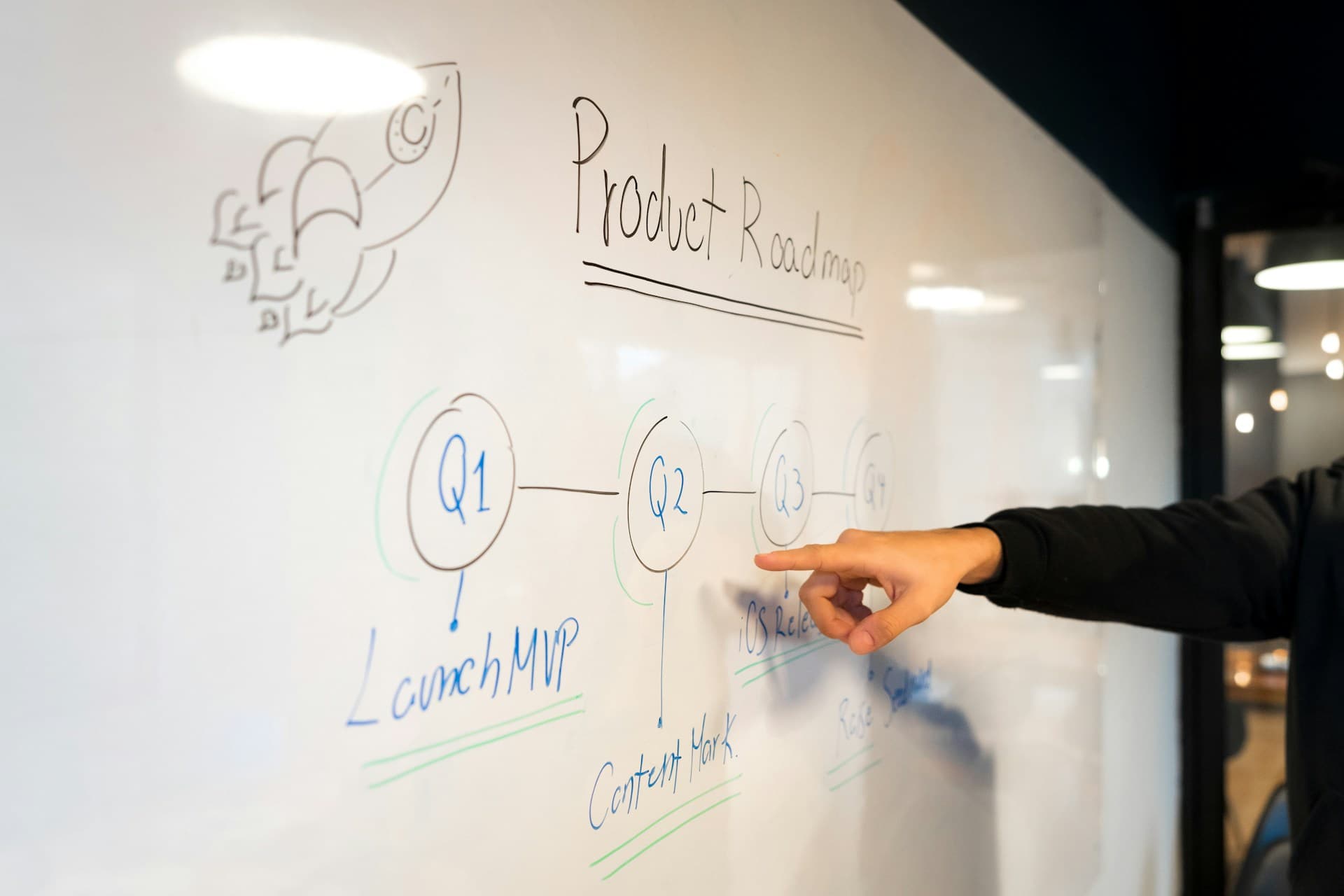
Why 90 Days
AI adoption isn’t an event — it’s a behavior change. And behavior change follows predictable timelines. Research on habit formation suggests that complex professional habits require 60-90 days to become automatic.
This framework is designed to make AI a permanent part of how your business operates — not a tool you try once and forget about. Each phase builds on the last, creating momentum that sustains itself.
A small business can achieve meaningful AI adoption in 90 days using a structured framework. Phase 1 (Days 1-14) establishes personal proficiency for the leader. Phase 2 (Days 15-45) integrates AI into daily workflows and key business processes. Phase 3 (Days 46-90) scales adoption across the team and measures ROI.
Phase 1: Foundation (Days 1-14)
Goal: The business leader becomes personally proficient with AI.
This phase is non-negotiable. Before you can lead AI adoption, you must experience it yourself. Leaders who skip this phase and delegate AI adoption to someone else consistently get worse outcomes — because they can’t evaluate what’s working, can’t troubleshoot problems, and can’t lead by example.
Days 1-3: Setup and First Contact
- Choose your AI tool: Claude Pro or ChatGPT Plus ($20/month)
- Complete the copy-paste test — paste something you wrote last week and ask AI to improve it
- Use AI for 3 real tasks: one email, one summary, one document draft
- Track time saved for each task
Days 4-7: Daily Driver
- Commit to using AI for every first draft — no exceptions for one week
- Learn the RCFS prompting framework: Role, Context, Format, Specifics
- Identify your top 5 most time-consuming text-based tasks
- Use AI on each one at least once
Days 8-14: Proficiency
- Use the voice-matching technique: paste examples of your writing and ask AI to match your tone
- Build a prompt library for your 5 most common tasks
- Draft your company’s AI usage policy (1-2 pages covering approved tools, permitted uses, review requirements, and data privacy)
- Calculate your personal ROI: hours saved × hourly rate × 52 weeks
Phase 1 Milestone
By Day 14, you should be using AI daily without thinking about it. It should feel natural — like checking email. If it still feels awkward or effortful, spend another week in Phase 1 before moving on.
Phase 2: Integration (Days 15-45)
Goal: AI becomes embedded in your core business workflows.
This is where the ROI starts to multiply. You move from personal productivity to business process improvement.
Days 15-21: Process Mapping
- Audit your business processes: list every repeatable text-based workflow (client onboarding, proposal creation, reporting, communication sequences)
- Score each process: time consumed per week × frequency × number of people involved
- Rank by AI leverage: which processes would benefit most from AI assistance?
- Select 3 high-impact processes to AI-enable first
Days 22-30: Workflow AI-ification
- For each selected process, create an AI-assisted version: prompts, templates, and review checkpoints
- Document the AI-assisted workflow in a simple SOP (AI can help write this too)
- Test the workflow yourself before introducing it to anyone else
- Measure: time per instance before AI vs. after AI
Days 31-45: Team Introduction
- Introduce AI to key team members — start with 2-3 people, not everyone at once
- Provide structured training, not just tool access (a login without training produces confusion, not adoption)
- Share your AI policy and set clear expectations
- Establish a feedback channel: weekly check-ins on what’s working and what’s not
- Lead by example — use AI visibly, share your wins, and normalize the learning curve
Phase 2 Milestone
By Day 45, you should have 3 core business processes running with AI assistance, and 2-3 team members using AI at least daily. You should be able to quantify time savings in hours per week.
Phase 3: Scale (Days 46-90)
Goal: AI adoption scales across the organization and becomes self-sustaining.
Days 46-60: Expand
- Roll AI out to remaining team members with the same structured training your early adopters received
- Add more processes to the AI-assisted workflow library
- Create role-specific prompt templates: what the sales team needs is different from what operations needs
- Consider formal training through programs like One Weekend AI Masterclass for comprehensive team upskilling
Days 61-75: Optimize
- Review all AI-assisted workflows: what’s working, what needs refinement, what should be added?
- Measure ROI formally: compare productivity metrics (tasks completed, time per task, client response time) to your pre-AI baseline
- Update your AI policy based on 60 days of real-world use
- Identify advanced opportunities: automation, integrations, custom AI tools
Days 76-90: Sustain
- Establish an ongoing cadence: monthly AI tool review, quarterly prompt library update, annual policy review
- Assign an internal AI champion — one person responsible for staying current on AI developments and sharing relevant updates with the team
- Plan the next phase: advanced automation, team training expansion, or specialized AI tool evaluation
- Document your results and ROI for future reference
Phase 3 Milestone
By Day 90, AI should be embedded in your organization’s daily operations. Every team member should be using AI for at least one task daily. You should be able to quantify the cumulative time savings and productivity improvement. And the question should have shifted from “should we use AI?” to “what else can we use AI for?”
The Leadership Factor
The single biggest predictor of successful AI adoption in a small business is the owner’s personal engagement. According to McKinsey research, organizations where leadership actively uses AI see 3-4x higher adoption rates than those where leadership delegates AI to IT or operations.
You don’t need to become a technical expert. You need to be a visible, enthusiastic user. When your team sees you using AI daily and talking about the results, adoption follows naturally.
Common Pitfalls and How to Avoid Them
- Starting too big. Don’t try to AI-enable everything at once. Start with 3 processes, prove the value, then expand.
- Skipping personal proficiency. Leaders who delegate AI adoption without personal experience lose credibility and miss critical context.
- Tool access without training. Giving employees an AI login without structured training produces confusion and resistance. Invest in training — either internal or through programs like One Weekend AI Masterclass.
- Not measuring results. If you can’t quantify the improvement, it’s hard to justify continued investment and expansion. Track time savings from Day 1.
- Expecting perfection. AI output requires review and editing, especially in the early stages. The goal is a strong first draft in seconds, not a perfect final product. Perfection expectations lead to disappointment; first-draft expectations lead to delight.
The Bottom Line
AI adoption is a 90-day journey, not a one-day event. The framework is straightforward: build personal proficiency, integrate into core workflows, then scale across the team. The organizations that follow this path systematically will be dramatically more productive than those that approach AI adoption randomly.
The roadmap is here. The tools are available. The only variable is your commitment to following through.